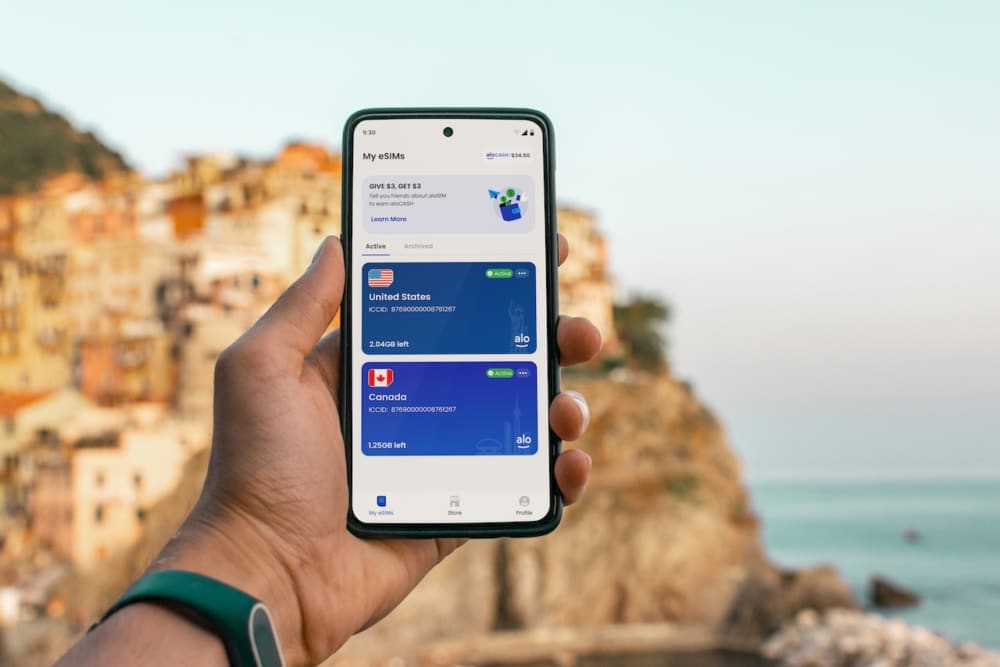
eSIM vs Roaming vs Local SIM review: decide before you board
There is no universal winner — there's a short decision tree. Trip length, number of countries, whether you need a local number, and whether your phone is unlocked settle the question in about four moves. The expensive mistake isn't picking the wrong option; it's defaulting to whatever your home carrier bills you for by doing nothing.

What we like
- Four questions genuinely resolve the choice for most trips
- Every option has a legitimate best case — none of the three is a scam
- Deciding before departure removes the worst outcome: accidental default roaming
- The framework holds even as individual prices shift
Flaws but not dealbreakers
- Locked phones collapse the tree to one branch before it starts
- Roaming pass terms differ wildly by carrier — no rule of thumb survives contact with them
- Local SIM quality and purchase friction vary enormously by country
Strip the marketing away and you're choosing between three ways to rent the same local networks. Roaming rents them through your home carrier at your home carrier's markup. A local SIM rents them directly, at local prices, with local paperwork. A travel eSIM sits in between: near-local pricing, bought in an app, no kiosk. Every option ends up on the same towers — you're only choosing the middleman and the markup. Once you see it that way, the comparison stops being about brands and starts being about your trip's shape — which is the honest basis for the choice.
Start with the question that can end the conversation: is your phone unlocked? A carrier-locked phone can't take a local SIM or a travel eSIM, which means roaming — or a pocket hotspot — is your whole menu. Check this weeks before departure, because unlocking is a carrier process with its own timeline. If the phone is unlocked and reasonably recent — eSIM support included — all three doors are open and the real comparison starts on equal footing.
The category context lives in our aloSIM.
Next, weigh trip shape. Short trip, one country: eSIM and roaming pass are both defensible — the eSIM usually costs less, the roaming pass keeps your number working exactly as at home, and which matters more is personal. Short trip, several countries: regional eSIMs were built for precisely this, while per-country roaming passes stack up fast. Long stay in one place: the local SIM takes over — more data for the money and a local number, at the cost of one visit to a shop with your passport. Between those poles, mixed itineraries reward mixing: an eSIM to land on, a local SIM if any single stop stretches long enough to deserve one.
The local-number question is the one people skip and regret. Travel eSIMs are typically data-only. If your trip involves local deliveries, restaurant bookings by phone, or apps that insist on verifying a local number, data-only will pinch. Meanwhile roaming's quiet advantage is the inverse: your home number keeps receiving the banking and two-factor texts your accounts depend on. The common workaround — home SIM stays active for texts, eSIM carries the data — covers most travelers, but only if you set it up deliberately.
One option is missing from most versions of this comparison and deserves a place in it: not buying data at all. A great deal of travel runs perfectly well on wi-fi in accommodation and cafés, with maps downloaded for offline use before leaving and a translation pack stored on the phone. That is not asceticism — it is the arrangement most travellers used until recently, and it still works. Where it fails is anything that needs connectivity while moving: ride-hailing, live transit information, and receiving verification codes. Deciding which of those you actually rely on is the honest way to size this purchase rather than defaulting to the largest plan.
There is a household angle too, since most families arrive with several phones. A single travel plan with hotspot sharing enabled can cover a group far more cheaply than one plan per person — worth checking, because some cheap plans specifically forbid tethering and enforce it. And for anyone travelling with a second device that only needs occasional access, the cheapest data plan on one phone plus sharing is almost always better value than two mid-sized plans.
Whatever you choose, choose before the plane door closes. The genuinely bad outcome in this category has always been the default one: landing with roaming on, no pass, no plan, and a per-megabyte rate you never agreed to think about. Fifteen minutes of decision at home beats any amount of optimization after the bill arrives — and every carrier and eSIM seller publishes current terms, so check those rather than any article's remembered prices, ours included.
Key specs
- Type
- Decision guide — travel connectivity
- The four questions
- Phone unlocked? Trip length? How many countries? Need a local number?
- The one rule
- Decide before you fly — doing nothing is the most expensive option