
Sort These Before You Fly: The Pre-Trip Services Checklist
Gear gets packed the night before; services can't be. Insurance wording, visa lead times, and phone unlocking all run on timelines you don't control, which is why the expensive travel mistakes are almost never about what's in the bag. Here's the order of operations, sorted by how badly each one punishes procrastination.
How to Read a Travel Insurance Policy
The one item no service can do for you: read the current policy's exclusions, activities, and pre-existing rules against your own trip.
iVisa
A capable middleman for messy or multi-country visa paperwork — as long as you know the direct government route is always there, always cheaper.
eSIM vs Roaming vs Local SIM
Four questions settle connectivity for almost any trip. The only losing move is the default one: landing with no plan and roaming switched on.
aloSIM
Once the phone's confirmed unlocked, this is the five-minute item on the list — buy, install, land connected.
Deadline-driven first
Two items on this list have government-shaped timelines: visas and phone unlocking. A visa requirement discovered late can sink a trip outright, so identify what your passport needs for each destination on official government sites the week you book — then decide whether a paid service like iVisa earns its fee for your case, knowing the direct route always exists and always costs less. Phone unlocking is a carrier process with its own clock; start it weeks out or lose the eSIM and local-SIM options entirely.
Reading-driven second
Travel insurance isn't a checkout checkbox — it's a document. Whatever policy you consider, the exclusions, covered-activities list, and pre-existing condition rules in the current wording on the insurer's own site are the parts that decide claims, and nobody can read them against your health and itinerary except you. Budget an unglamorous evening for this. It's the only item here where the homework genuinely cannot be delegated.
Five-minute jobs last
Connectivity is the easy one — a travel eSIM installs in minutes once your phone is confirmed unlocked, so it can wait until the final days. The remaining task costs nothing and needs no product at all: decide now that every card terminal and ATM abroad gets answered in local currency. Some of the best pre-trip preparation is just a rule you commit to before you're tired in a queue.
How to Read a Travel Insurance Policy

The one item no service can do for you: read the current policy's exclusions, activities, and pre-existing rules against your own trip.
What we like
- Three-section reading order covers where most claim disputes actually live
- Works on any insurer's policy — the skill transfers
- Reading before buying costs nothing and can't be done after the incident
- Turns marketing summaries back into what they are: marketing
Flaws but not dealbreakers
- Policy documents are long and written to be skimmed past — reading them is genuine work
- No reading technique substitutes for asking the insurer directly when your case is ambiguous
- Wording changes over time, so the homework repeats at each renewal
iVisa

A capable middleman for messy or multi-country visa paperwork — as long as you know the direct government route is always there, always cheaper.
What we like
- Turns scattered, badly translated government requirements into one clear checklist
- Reviews your application before submission — the value is in mistakes not made
- One familiar interface across many countries instead of a new portal each time
- Handles supporting extras like compliant photos alongside the application
Flaws but not dealbreakers
- Every application can be done cheaper directly through the official government channel
- Service fee comes on top of the government fee — the total is easy to misread as the visa's cost
- For simple eVisas, the official portal is often easy enough that paying help adds little
- Processing-time promises still depend on the government behind the curtain
eSIM vs Roaming vs Local SIM

Four questions settle connectivity for almost any trip. The only losing move is the default one: landing with no plan and roaming switched on.
What we like
- Four questions genuinely resolve the choice for most trips
- Every option has a legitimate best case — none of the three is a scam
- Deciding before departure removes the worst outcome: accidental default roaming
- The framework holds even as individual prices shift
Flaws but not dealbreakers
- Locked phones collapse the tree to one branch before it starts
- Roaming pass terms differ wildly by carrier — no rule of thumb survives contact with them
- Local SIM quality and purchase friction vary enormously by country
aloSIM
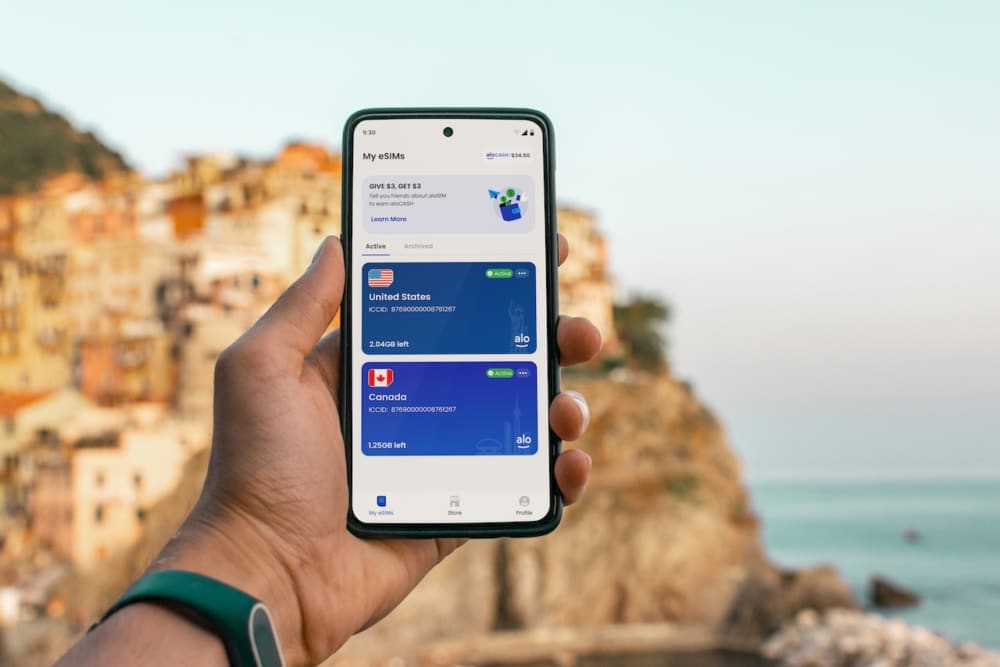
Once the phone's confirmed unlocked, this is the five-minute item on the list — buy, install, land connected.
What we like
- Prepaid packages bought and activated entirely from the app — nothing physical to collect
- Country and regional options cover the mainstream travel map
- Pay-as-you-go structure suits short trips without a contract hangover
- Keeping your home SIM active alongside preserves banking and verification texts
Flaws but not dealbreakers
- Requires an unlocked, eSIM-capable phone — carrier-locked handsets are out
- Typically data-only: no local phone number for calls or SMS
- Coverage quality depends on which local network the package rides on, and varies by country
- Long stays in one country can still favor a local SIM bought in person